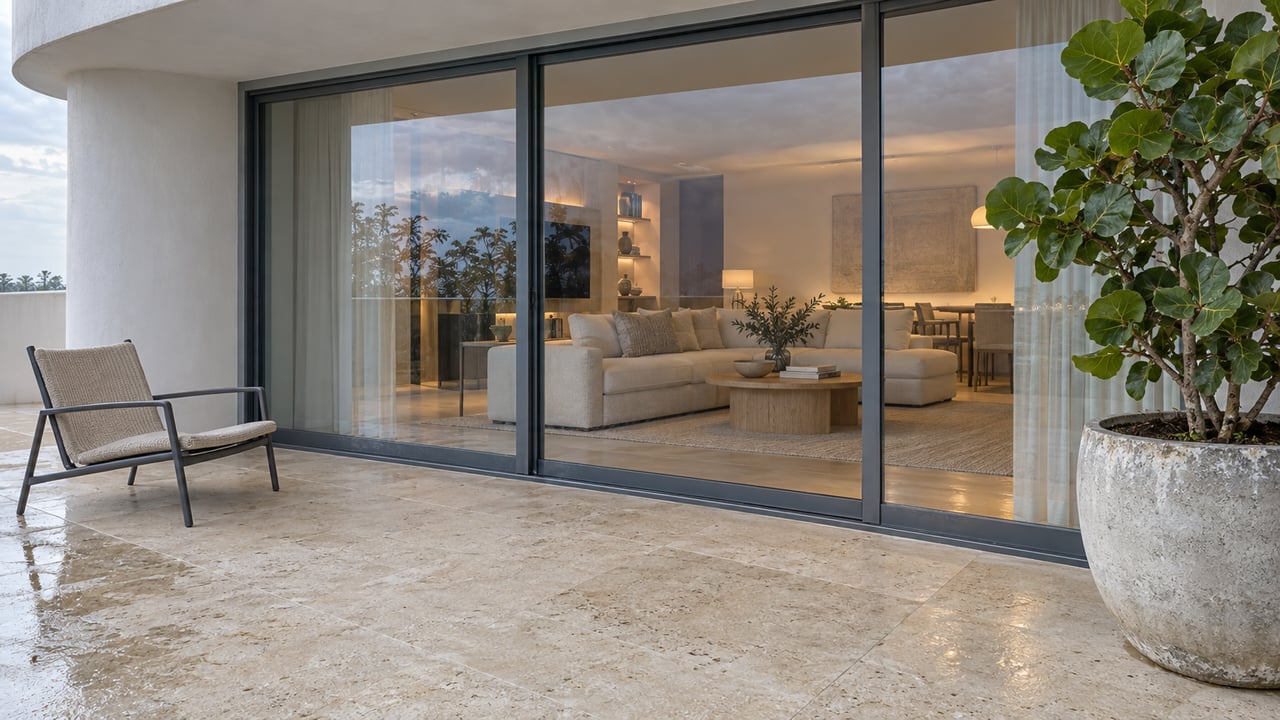
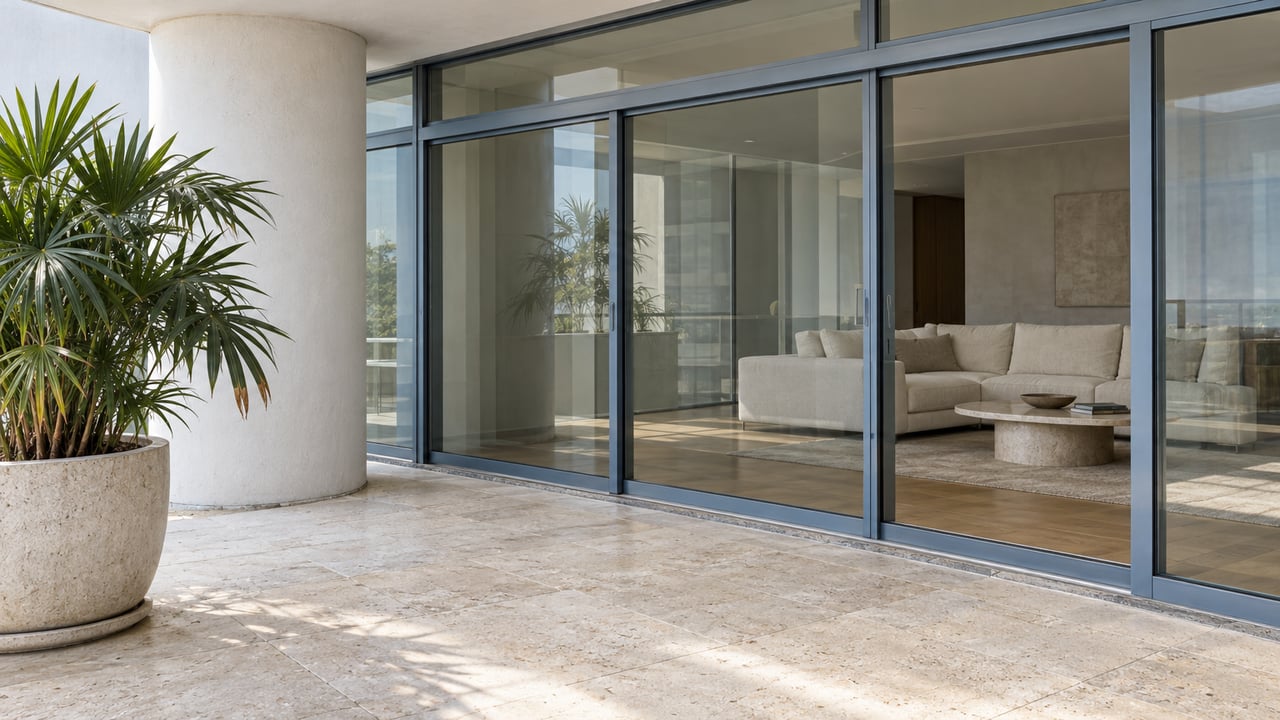
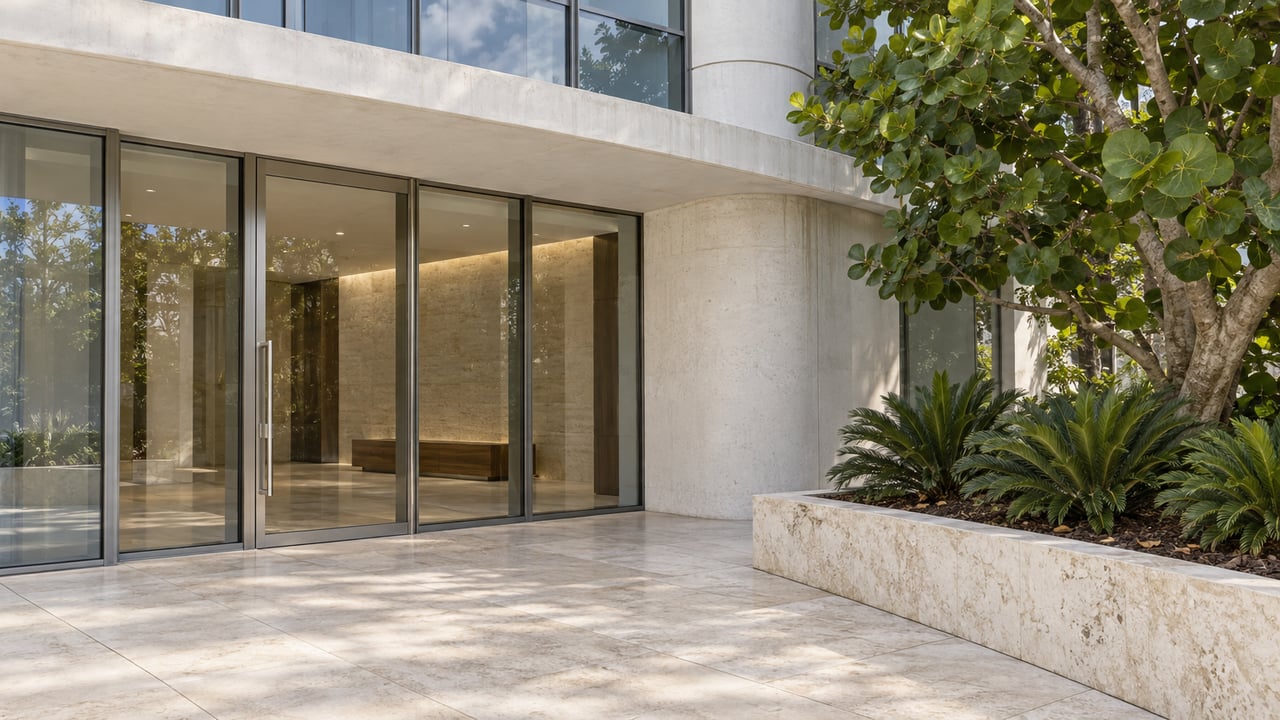
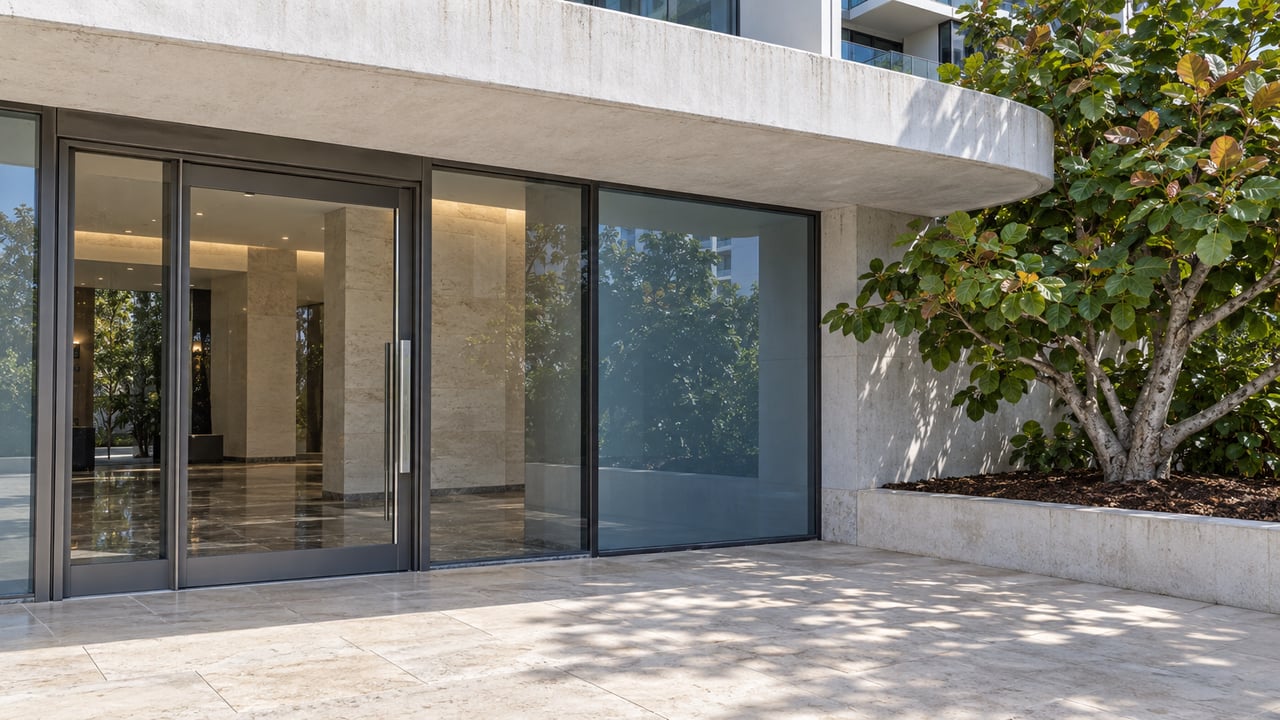
The Grove's median condo price is a poor guide to what a Grove condo actually costs. Two buildings can share a Bayshore Drive address, sit on the same seawall, and trade at a four-fold spread on price per square foot. The portal median averages them together and tells you almost nothing about which side of that spread you are underwriting.
This is not a story about location premium. It is a story about how a small number of new-build allocations are cloning a new ceiling across the neighborhood, while the older stock along the same corridor is being repriced for costs the previous owners never carried.
The Number That Reframes The Median
The single most instructive Grove data point of the last three years is not a median. It is a ceiling. A January 2026 closing at 3085 Munroe Dr traded at roughly $6,913 per square foot, a Grove-waterfront trophy ceiling that did not exist in 2023, 2024, or 2025.
Set that against the neighborhood-wide read. As of mid-2026, the median sale price in Coconut Grove was about $2.6 million over the trailing three months, up roughly 52.7% from the same period a year earlier, with a median of around $909 per square foot, on a market where homes were taking on the order of 87.5 days to sell.
A 52.7% year-over-year median jump in a market taking almost three months to clear is not a market lifting uniformly. It is a market where mix shift is doing the heavy lifting and the ceiling is pulling the average behind it.
Why The Ceiling Keeps Moving Up While The Median Crawls
The Grove's single-family and condo tiers have moved in opposite directions on the same three-year window, and the divergence is the market's most useful signal for anyone comparing buildings this year.
On the house side, the inland trophy ceiling has moved +79.2% in three years while the median has only moved +50.5%, meaning the top of the Grove single-family market has sprinted ahead of the middle of the market at a rate most market summaries gloss over.
Condos have done the opposite. Park Grove's ceiling has crept up by 15% in three years while the median has moved 11.5%. The condo ceiling has been more patient. It was already at $3,350 per square foot in 2023 when Park Grove Tower 1 set its A-line record. The story for condos isn't ceiling acceleration; it's new supply at the ceiling. Four Seasons Coconut Grove pre-construction at $3,000 to $4,000 per square foot, delivering Q4 2028, is effectively cloning the Park Grove ceiling across an entire new building.
That distinction is what most Grove condo buyers get wrong. They read a rising median and assume the whole market is repricing upward. What is actually happening is that a new building is being priced at the old ceiling, so the ceiling itself becomes the new floor for the branded-boutique tier. The mid-market is not being pulled up with it.
The Three-Building Concentration Nobody Prices In
The developer roster at the top of the Grove condo market is smaller than the buyer pool assumes. CMC Group, Ugo Colombo's firm, is on track to control three of the highest-priced buildings on the corridor.
Vita at Grove Isle, delivered in late 2025 with closings running through 2026, is the most consequential of them. Vita is one of the rare newly completed waterfront luxury buildings on a private island, with only 65 total residences, each directly on the water. It is the first new-build residential tower on Grove Isle since the original Margulies trio in 1981, and it gives CMC Group, already the developer of Grovenor House and Four Seasons Coconut Grove, three of the highest-priced condominiums in the Grove.
The Four Seasons Private Residences groundbreaking, layered on top of Vita's final closings and the Grovenor House resale market, means one developer's pricing decisions set the anchor point for a meaningful share of the trophy inventory. In a neighborhood with roughly a dozen buildings worth calling comparable, that concentration is a real variable in any comp set.
The pre-construction pipeline behind them reinforces the effect. Four Seasons Private Residences targeting 2028, The Well Coconut Grove targeting Q1 2028, The Lincoln Coconut Grove targeting Q3 2028, and OPUS Coconut Grove targeting 2027 are the four active preconstruction projects on the corridor and adjacent streets. Each one is being priced against Park Grove, Grove at Grand Bay, and Vita rather than against the older Bayshore towers half a block away.
What The Discount On Older Bayshore Stock Is Actually Pricing
The other half of the spread is the one buyers usually misread as a bargain. Bayfront new-build price per square foot runs $1,100 to $2,800 and up on the newer product, while older condos on the same water trade meaningfully below that band. The gap is not about view or address. It is about what the HOA balance sheet is being asked to carry.
Grove buyers this cycle are underwriting differently than they were three years ago. In 2026, condo buyers are more cautious because of costs that don't show up in the purchase price: HOA fees, insurance, reserves, and special assessments. Buyers are underwriting total ownership cost, not just price, and insurance is a deal-maker or deal-breaker, especially for older homes and coastal-adjacent properties.
That is the mechanism behind the discount. Legacy Bayshore buildings like Yacht Harbour, Grove Towers, Grove Hill, and Grovenor House sit on the same bay as Park Grove and Vita, but their reserve studies, structural inspection status, and insurance renewals are now being repriced into the offer. Bayfront PSF on newer-construction condos runs $1,100 to $2,800 and up, with branded service driving the upper end, while older-condo PSF sits well below, even when waterfront, reflecting amenity and reserve-funding gaps.
For an investor comparing two units listed at the same price on portals, one in a 2020s branded building and one in a 1980s bayfront mid-rise, the "value" side of that trade is often carrying the entire cost of catching the older building up to current standards. That is a defensible bet only if the reserve study, the current assessment schedule, and the next insurance renewal are all sitting on the table before the offer.
The Transaction Friction That Surfaces At Contract
The friction is not in the listing. It is in the paperwork after the offer. A short list of items that catch Grove condo buyers off guard this year, in the order they usually surface:
- The reserve and assessment status of any pre-2000 building. Reserve strength, owner-to-renter ratios, and assessment risk are now the primary variables separating the top-performing and underperforming Grove condos.
- The distinction between a completed building and a pre-construction allocation. Recently completed buildings like Mr. C and Vita are delivered and ready for immediate occupancy, so you can see the unit, verify the finishes, and close quickly, while pre-construction like Four Seasons and The Well involve a deposit structure, a delivery timeline, and contract risk that needs careful review before you sign.
- The Florida tax reset on change of ownership. The prior owner's tax bill is not the bill the next owner inherits. Any pro forma built off the current tax line understates carrying cost from day one.
- The thin visible pipeline. Holding periods run materially longer than Brickell or Miami Beach, the pied-à-terre culture is thin, and together this compresses the visible resale pipeline and concentrates negotiating leverage with sellers in the bayfront and gated-enclave segments. Buyers who assume they can wait out the market often discover the specific line and floor they want has not traded in eighteen months.
Each of these is a normal transaction detail. Read together, they explain why two Grove condos priced within 10% of each other on the portal can produce five- and six-figure differences in year-one carrying cost.
How This Changes The Comp Set
The practical read for a buyer in 2026 is that a Grove comp set built on price per square foot alone is broken. The variables that actually determine whether a unit is priced correctly are the vintage of the building, the identity of the developer, the reserve position of the HOA, and the level of branded service the building carries.
The buyer profile the neighborhood is now pricing for reflects that. Coconut Grove consistently attracts relocating families and end-users seeking a permanent primary residence in a place that feels established, walkable, and emotionally rooted rather than seasonal or transactional, and this migratory end-user demand is the single most important force shaping Coconut Grove home prices and condo values in 2026. That buyer holds longer, underwrites total cost more carefully, and is less forgiving of a building that will need capital calls in year three.
Anyone comparing Grove buildings this year is really comparing three markets stacked on the same waterfront: a branded new-build tier being cloned upward by CMC and its peers, a design-driven established tier at Park Grove, Grove at Grand Bay, and The Fairchild, and an older Bayshore tier whose discount is doing real work covering deferred costs. The waterfront premium the portal shows you is the average of all three. It is not what any single building is actually pricing.
Questions Buyers Ask At The Table
Is the Grove condo market still small enough to matter? Yes. The Coconut Grove Q1 2026 Market Report recorded over 66 closings in Q1, with waterfront and gated properties driving the deepest concentration of ultra-luxury activity. That volume is thin enough that a single trophy closing meaningfully moves the reported averages.
Does the private-island access at Grove Isle actually price differently than a mainland bayfront building? It does, and the mechanism is structural rather than aspirational. No other new-construction luxury condo in Coconut Grove or Brickell sits on a private island, and the controlled-access gatehouse, the Baywalk Promenade, and the inherent separation from mainland density create a lifestyle that tower developments cannot replicate. That scarcity is being priced into every Vita line and into Grove Isle I, II, and III resale.
What is the newest completed building buyers can walk today? Arbor Coconut Grove received its temporary certificate of occupancy in March 2026 with move-ins starting spring 2026. Before Arbor, Vita received TCO in December 2025 and the two Mr. C buildings completed in 2024.
Underwriting a Coconut Grove condo in 2026 is an exercise in reading three markets on one map. If you are evaluating a specific building, line, or allocation, JJABREU Group can walk you through the reserve position, the developer pipeline behind the ceiling, and the comparable sales that actually apply. To review Grove inventory alongside adjacent submarkets, our Coconut Grove neighborhood page and current development roster are the right place to start. Schedule a Private Consultation.